How much does home solar cost in Los Angeles?
Current market prices by system size, what the end of the 30% homeowner credit means, and why an LADWP home and an SCE home get different answers.
Short answer
Home solar in Los Angeles averages about $2.51 per watt in 2026, roughly $25,000 for a typical 10 kW system before incentives, according to EnergySage’s Los Angeles data updated October 2, 2026. Homeowners who buy a system completed after December 31, 2025 no longer get the 30% federal residential credit. Inside the City of Los Angeles the utility is LADWP, which uses its own net metering rather than NEM 3.0, so payback is calculated differently from SCE areas of the county.
On this page
What home solar costs in Los Angeles
Residential solar is priced in dollars per watt of DC capacity. EnergySage, which publishes quote data from its marketplace, lists the following for Los Angeles as of October 2, 2026. These are market figures, not a Current Energy quote.
| System size | Typical cost | Notes |
|---|---|---|
| 5 kW | $12,545 | Small home or partial offset |
| 8 kW | $20,073 | |
| 9.97 kW (LA average) | $25,017 | Range $21,264–$28,770 |
| 10 kW | $25,091 | At the $2.51/W average |
For context, California as a whole averages $2.52 per watt on EnergySage, with a typical 8.42 kW system at about $21,200. Nationally, Lawrence Berkeley National Laboratory found that loan-financed residential systems installed in 2024 had a median price of $4.7 per watt against $3.5 for cash purchases, partly because loan fees are rolled into the price, and that the most common price point for cash purchases was below $3 per watt. In other words, how you pay can move the headline number as much as what you buy.
EnergySage lists an average Los Angeles electric bill of about $250 a month. Your own bills matter more than any average: system size should come from twelve months of usage, not from roof area.
What changed in 2026
The 25D credit ended
The IRS says the residential clean energy credit does not apply to expenditures made after December 31, 2025, and an expenditure is made when installation is completed. A homeowner-owned system finished in 2026 gets no federal credit.
Leases and PPAs still have a credit behind them
Third-party-owned residential solar can still qualify for the business credit under Section 48E, but a solar facility that began construction after July 4, 2026 must be in service by December 31, 2027.
State storage incentives are wait-listed
California’s SGIP has only its equity-focused budget left, fully reserved with a waitlist. See our battery cost guide.
Property tax treatment unchanged here
California’s solar property tax exclusion is covered in our solar property tax guide.
Not tax or legal advice
Current Energy is a licensed contractor. This page summarises publicly available rules as they stood on October 8, 2026 and is not tax, legal or financial advice. Programs change. Confirm anything that affects a real decision with your CPA, tax counsel or the program administrator.
LADWP or SCE: why it changes the value
The same system on the same roof is worth different amounts in different utility territories, because each utility credits exported energy differently.
| LADWP (City of Los Angeles) | SCE (much of LA County outside the city) | |
|---|---|---|
| Program | LADWP net energy metering rider | Solar Billing Plan (CPUC Net Billing Tariff, “NEM 3.0”) |
| Export value | Excess energy credited at your rate schedule’s energy pricing | Hourly export credits; SCE’s 2026 averages: summer 6¢ daytime, 21¢ 4–9 p.m., 12¢ overnight; winter 3¢, 10¢, 10¢ per kWh |
| Extras | Credits carry forward; cannot pay taxes or minimum charges | About 4¢/kWh bonus credit for eligible residential customers enrolling before 2028; values locked for nine years |
| Rate | Your LADWP residential schedule | TOU-D-PRIME |
For an SCE home, a battery is often what makes the numbers work, because daytime exports earn little. For an LADWP home, the case for a battery is more about backup and rate structure. Read NEM 3.0 explained for SCE detail and LADWP solar programs and rebates for LADWP.
Buy, lease or PPA
| Option | What you pay | Who claims federal credit | Watch for |
|---|---|---|---|
| Cash | Full price up front | Nobody (25D ended for homeowners) | Lowest lifetime cost if you stay |
| Loan | Monthly payments plus interest | Nobody | Dealer fees built into the price |
| Lease | EnergySage lists $60–$243 a month | The leasing company, if eligible | Escalators, transfer on sale, removal terms |
| PPA | EnergySage lists $0.12–$0.29 per kWh | The PPA provider, if eligible | Escalators; rate versus your LADWP tariff |
What pushes a Los Angeles quote up
- Roof type and condition. Tile roofs take more labour than composition shingle, and an array should not go on a roof that will need replacing within its life. See roofing.
- Electrical service. Many older Los Angeles and Valley homes have 100-amp service with no spare capacity. A panel upgrade can add thousands, and on LADWP it moves a small system from the simplest interconnection path to the next one.
- Batteries. Storage is priced per kWh and adds substantially. See home battery cost in California.
- Permits and utility fees. LADBS permits are required for electrical work, and LADWP charges a one-time $130 expenditure recovery charge per net metering interconnection submittal.
- Equipment. Microinverters versus string inverters, premium modules and monitoring all change price and warranty.
Questions to ask any Los Angeles solar quote
- What is the system size in kW DC, the modelled first-year production in kWh, and what share of my annual usage does that cover?
- Was the production model built for my utility’s rules (LADWP net metering or SCE’s Solar Billing Plan), or a generic one?
- Is the price fixed, and does it include the LADBS permit, LADWP or SCE fees, and any panel work?
- Who owns the system, and who claims any federal credit? If it is a lease or PPA, what is the annual escalator and what happens when I sell the house?
- What are the module, inverter and workmanship warranties, in years and in writing, and who honours them if the installer is gone?
- Will the roof outlast the array? If not, what does removal and reinstallation cost later?
- Who monitors the system after it is switched on, and what happens if it underperforms?
A quote that cannot answer these clearly is not cheaper; it has simply left the costs for later.
LADWP programs that affect cost
LADWP does not currently list an upfront per-watt rebate for customer-owned rooftop solar on its solar programs page. The programs it does list include:
- Net energy metering for customer-owned systems. Systems of 10 kW or less on single-phase service usually follow LADWP’s simplest interconnection path, with no interconnection agreement and a photo inspection, unless the job includes a panel upgrade.
- Solar Rooftops. LADWP builds and owns a 1–10 kW system on an eligible owner-occupied single-family home (composition shingle roof, residential rate R1A, R1B, R1D or R1E) and pays the homeowner up to $900 a year for 20 years, up to $18,000. LADWP keeps the energy and your bill is not affected.
- Shared Solar for residents of multifamily buildings, and SGIP for qualifying income-eligible customers.
How we price a home
From a site-specific design: twelve months of usage, roof condition, shading, the main panel and the utility’s rules, then a site-specific quote. As a market reference, EnergySage’s Los Angeles average is $2.51 per watt (October 2026); a firm quote depends on the roof, the main panel, the utility and the timeline. Call our home services line on (818) 405-9062 or see residential solar.
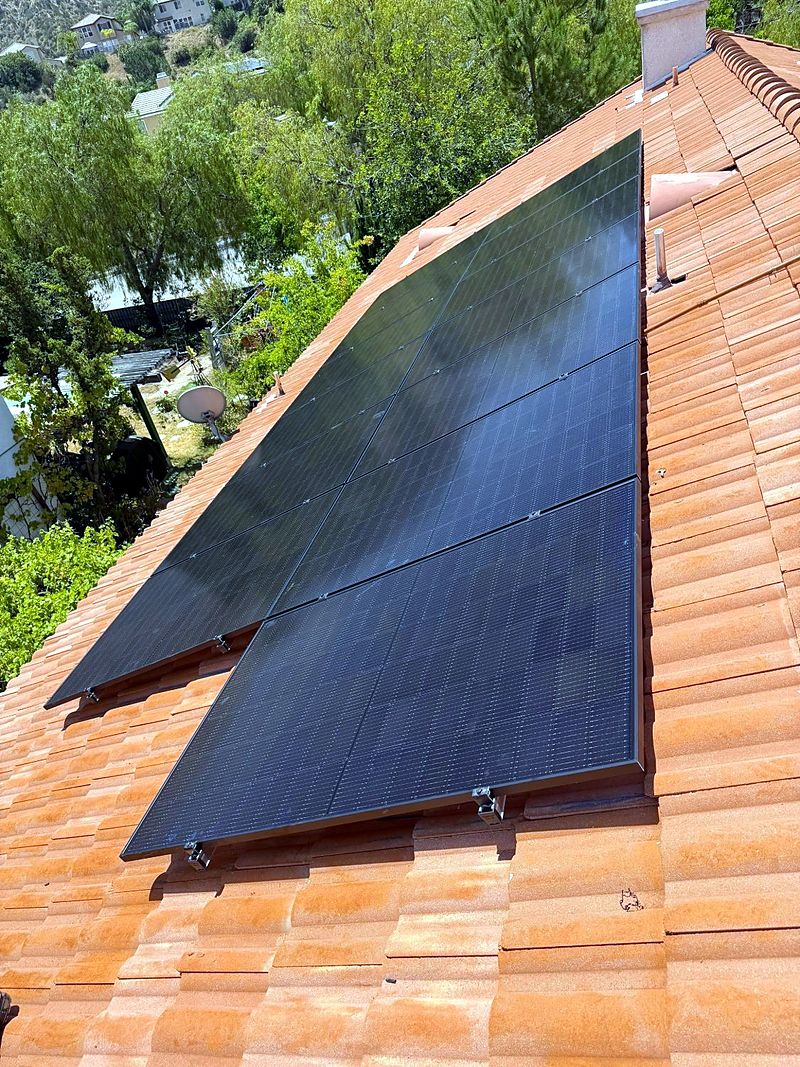
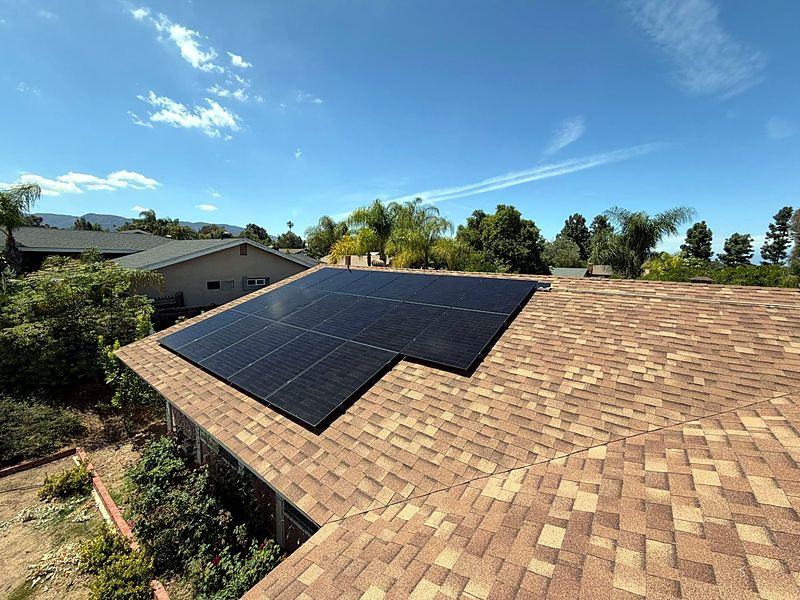
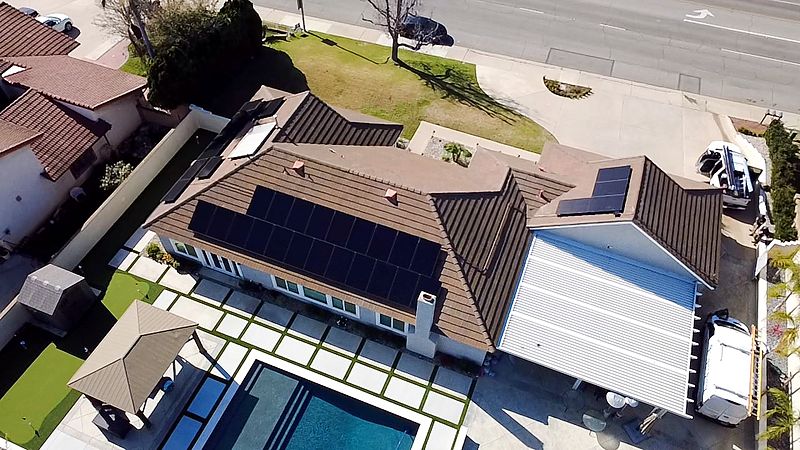
23 photographs from our own jobs →
Sources and further reading
- EnergySage — Cost of solar panels in Los Angeles, CA (updated October 2, 2026) — accessed October 8, 2026
- EnergySage — California solar panel cost data — accessed October 8, 2026
- Lawrence Berkeley National Laboratory — U.S. Distributed Solar and Storage: 2025 Data Update — accessed October 8, 2026
- IRS — FAQs for modification of sections 25C, 25D, 25E, 30C, 30D, 45L, 45W and 179D under Public Law 119-21 (OBBB) — accessed October 8, 2026
- 26 U.S.C. § 48E — Clean electricity investment credit (Cornell LII) — accessed October 8, 2026
- LADWP — EV, Net Energy Metering and REO rates — accessed October 8, 2026
- LADWP — Net Energy Metering — accessed October 8, 2026
- LADWP — Solar interconnection requirements — accessed October 8, 2026
- SCE — How Solar Billing Plans work — accessed October 8, 2026
- LADWP — Solar programs — accessed October 8, 2026
- LADWP — Solar Rooftops fact sheet (rev. April 2026, PDF) — accessed October 8, 2026
- SGIP — Program budget and waitlist status — accessed October 8, 2026
- EnergySage — Cost of battery storage in California (updated October 4, 2026) — accessed October 8, 2026
Questions we get asked
How much does a solar system cost for a home in Los Angeles?
EnergySage’s Los Angeles data (updated October 2, 2026) puts the average at $2.51 per watt, or about $25,017 for an average 9.97 kW system, with a typical range of $21,264 to $28,770 before incentives. Your price depends on system size, roof type, electrical service and equipment.
Is there still a 30% federal tax credit for home solar?
Not for homeowners who buy their system. The IRS says the Section 25D residential clean energy credit does not apply to expenditures made after December 31, 2025, and an expenditure counts as made when installation is completed. Third-party-owned systems (leases and PPAs) are a different case because the owner, not the homeowner, may claim the business credit.
Is Los Angeles on NEM 3.0?
Homes in the City of Los Angeles are served by LADWP, a municipal utility that is not part of the CPUC’s Net Billing Tariff. LADWP runs its own net energy metering rider. Homes elsewhere in Los Angeles County served by SCE are under SCE’s Solar Billing Plan (the Net Billing Tariff).
What does LADWP pay for extra solar power?
Under LADWP’s net energy metering rider, excess energy is credited at the energy pricing of your rate schedule. Credits carry forward but cannot be used for taxes or minimum charges, apply only to the meter that measured them, and are zeroed when service ends. Check LADWP’s rate pages for current figures.
Is leasing or a PPA cheaper than buying in 2026?
Not automatically. With no 25D credit for buyers, third-party ownership looks relatively better than it did, because the leasing company may still claim a business credit and pass some of it through. EnergySage lists Los Angeles PPA rates of $0.12 to $0.29 per kWh and leases of $60 to $243 per month. Compare total 20-year cost, escalators and what happens when you sell the house.
Can I get free solar from LADWP?
LADWP’s Solar Rooftops program installs and owns a 1–10 kW system on eligible owner-occupied single-family homes with composite shingle roofs and pays the homeowner up to $900 a year for 20 years for use of the roof. LADWP keeps the energy, so your electric bill does not change.
Does adding a battery change the cost much?
Yes. EnergySage’s California data puts storage at about $1,037 per kWh, or roughly $13,482 for a 13 kWh battery before incentives. Whether it pays back depends on your utility and rate. See our home battery cost guide.
Last updated October 2026
A real price for your roof, not an average.
Send twelve months of LADWP or SCE bills and a photo of your main panel. We will size the system to your usage and quote it from a site-specific design.