Commercial solar in Los Angeles, built for LADWP rules
Offset your own load under LADWP net metering or sell to LADWP through the Feed-in Tariff. We design, permit and build both in-house, from an office inside the city.
Short answer
Commercial solar in Los Angeles is a different calculation from the rest of Southern California because most of the city is served by LADWP, not SCE. LADWP customers can offset their own load under LADWP’s net energy metering rider (customer-owned systems up to 1 MW) or sell output to LADWP through the Feed-in Tariff. Current Energy designs, permits and builds both, in-house, from Sylmar. On the federal side, a solar facility that began construction after July 4, 2026 must be placed in service by December 31, 2027 to claim the Section 48E credit, so schedule now matters as much as price.
On this page
Which utility serves your building
Inside the City of Los Angeles, electricity is supplied by the Los Angeles Department of Water and Power. LADWP is a municipal utility, so it is not bound by the California Public Utilities Commission decision that created the Net Billing Tariff (“NEM 3.0”) for SCE, PG&E and SDG&E customers. It writes its own net metering, interconnection and incentive rules, and it changes them on its own schedule.
That is why advice written for an SCE customer in Santa Clarita or Long Beach can be wrong for a warehouse in Sun Valley or an office in Westwood. Before we model anything, we confirm the utility on the bill, the rate schedule and the service size. For SCE sites in the county, see NEM 3.0 explained.
Two ways to go solar on LADWP
LADWP gives commercial owners two distinct paths. The right one depends on how much electricity the building uses during the day and how much roof or parking area it has.
| Net energy metering (NEM rider) | Feed-in Tariff (FiT) | |
|---|---|---|
| What you do with the power | Use it on site; excess is credited on your bill | Sell all output to LADWP under contract |
| Size | Customer-owned systems up to 1 MW that primarily offset your own load | In-basin solar from 30 kW; price tiers for 30–500 kW, over 500 kW–3 MW and over 3 MW |
| Value of energy | Excess energy credited at your rate schedule’s energy pricing; credits carry forward but cannot pay taxes or minimum charges | LADWP lists 14.5¢/kWh (30–500 kW), 14.0¢ (over 500 kW–3 MW), 13.5¢ (over 3 MW) |
| Term | Ongoing under the rider | 20-year contract, or 10 years with extensions |
| Extras | Systems over 10 kW need an Interconnection Agreement; customer pays interconnection costs | Carport & Canopy Incentive of $1.20–$1.70 per watt for systems under 3 MW, depending on size and location |
| Availability | Open | LADWP reported 57.8 MW of 235 MW still available as of September 18, 2026; waitlist when full |
LADWP also runs FiT+, a competitive pilot for solar paired with storage of up to 35 MW in total, with interconnection cost reimbursement. Its first tranche window ran May 18 to August 16, 2026; watch for the next one if you have a large site and can bring a project online within twelve months of award.
FiT applications carry fees (application, integration study and, where required, interconnection study) and a $50 per kW development security deposit, all listed on LADWP’s program page. Our own Chatsworth project was a Feed-in Tariff job; see below.
The federal deadline that now drives schedules
The 2025 budget law (Public Law 119-21) kept the Section 48E clean electricity investment credit for businesses but put a clock on solar. Under 26 U.S.C. § 48E as amended, a solar facility whose construction began after July 4, 2026 gets no credit if it is placed in service after December 31, 2027. For most Los Angeles projects starting design now, that is the real deadline.
6% base, 30% for most commercial jobs
The credit is 6% of qualified cost, multiplied to 30% for facilities under 1 MW AC or for projects that meet prevailing-wage and apprenticeship requirements. Bonus adders exist for domestic content and energy communities.
Storage is not on the same clock
The 2027 placed-in-service cutoff applies to wind and solar facilities. Energy storage technology keeps its own, longer phase-down, which makes a battery added to a solar project worth a separate look.
Depreciation still helps
Section 48E property remains five-year MACRS property, and the 2025 law made 100% bonus depreciation permanent for qualifying property acquired after January 19, 2025.
Beginning of construction is contested
IRS Notice 2025-42 removed the 5% cost safe harbor for most solar. A federal court vacated that notice on June 6, 2026; the ruling may be appealed. Document start-of-construction work carefully either way.
New “prohibited foreign entity” sourcing restrictions also apply to many projects that begin construction after December 31, 2025, so equipment documentation is now part of the design file. Read our federal solar tax credit guide for the detail.
Not tax or legal advice
Current Energy is a licensed contractor. This page summarises publicly available rules as they stood on October 8, 2026 and is not tax, legal or financial advice. Programs change. Confirm anything that affects a real decision with your CPA, tax counsel or the program administrator.
What commercial solar costs in Los Angeles
There is no official Los Angeles price list. The best public benchmark is Lawrence Berkeley National Laboratory’s Tracking the Sun: for large (over 100 kW) California systems installed in 2023, it reported a median installed price of $2.3 per watt for commercial customers, $2.0 for agricultural and $4.1 for tax-exempt sites, before incentives. LBNL’s 2025 update adds that non-residential prices show clear economies of scale, about a $2 per watt spread in median price across system sizes, and that pairing storage added a median of $0.8 per watt for large non-residential systems and $2.2 for small ones.
Our commercial solar cost guide breaks the California market down by size. For Los Angeles specifically, the items that move a quote are LADWP interconnection requirements, roof condition, the distance from the array to the point of interconnection, and whether the service can accept the system without an upgrade. Market data for large (over 100 kW) California commercial systems puts the median at about $2.3 per watt (Berkeley Lab, 2024 edition, 2023 installs); a firm quote depends on the roof, the utility’s requirements and the timeline.
How an LA project runs
- Feasibility. Twelve months of bills or interval data, the rate schedule, roof age and structure, and the main switchboard. We tell you plainly if the site is not worth a design.
- Design and engineering. Sized to load for the NEM path, or to the roof or parking area for FiT. Structural review, single-line diagram and production model.
- LADBS permit and LADWP application. Systems over 10 kW need an Interconnection Agreement. From 30 kW up to 1 MW, LADWP requires engineering review and a mandatory pre-construction meeting; 1 MW and above follows a separate process.
- Build. Our own crews, with roof-first sequencing where the roof will not outlast the array.
- Inspection, permission to operate and monitoring. We stay on the system after commissioning.
LADWP does not publish a standard end-to-end timeline for commercial solar. How long a project takes depends on its interconnection type, any utility upgrades the site needs and LADBS plan check, so for the federal credit, plan backwards from the December 31, 2027 placed-in-service deadline.
Work in Los Angeles
At Van Nuys Airport, 6,569 modules cover nine hangar roofs and two carports, about 150,000 square feet of roof, producing 4.5 million kWh a year. In Chatsworth, a Feed-in Tariff project put 3,000 modules on a 100,000 sq ft building and 324 more on two new carports, added eight EV charging stations, and replaced the roof first at no cost to the owner.
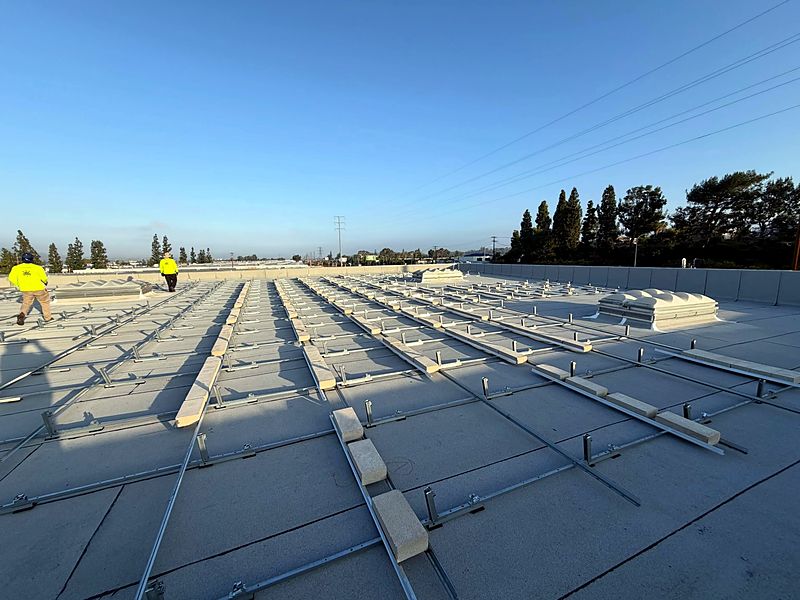
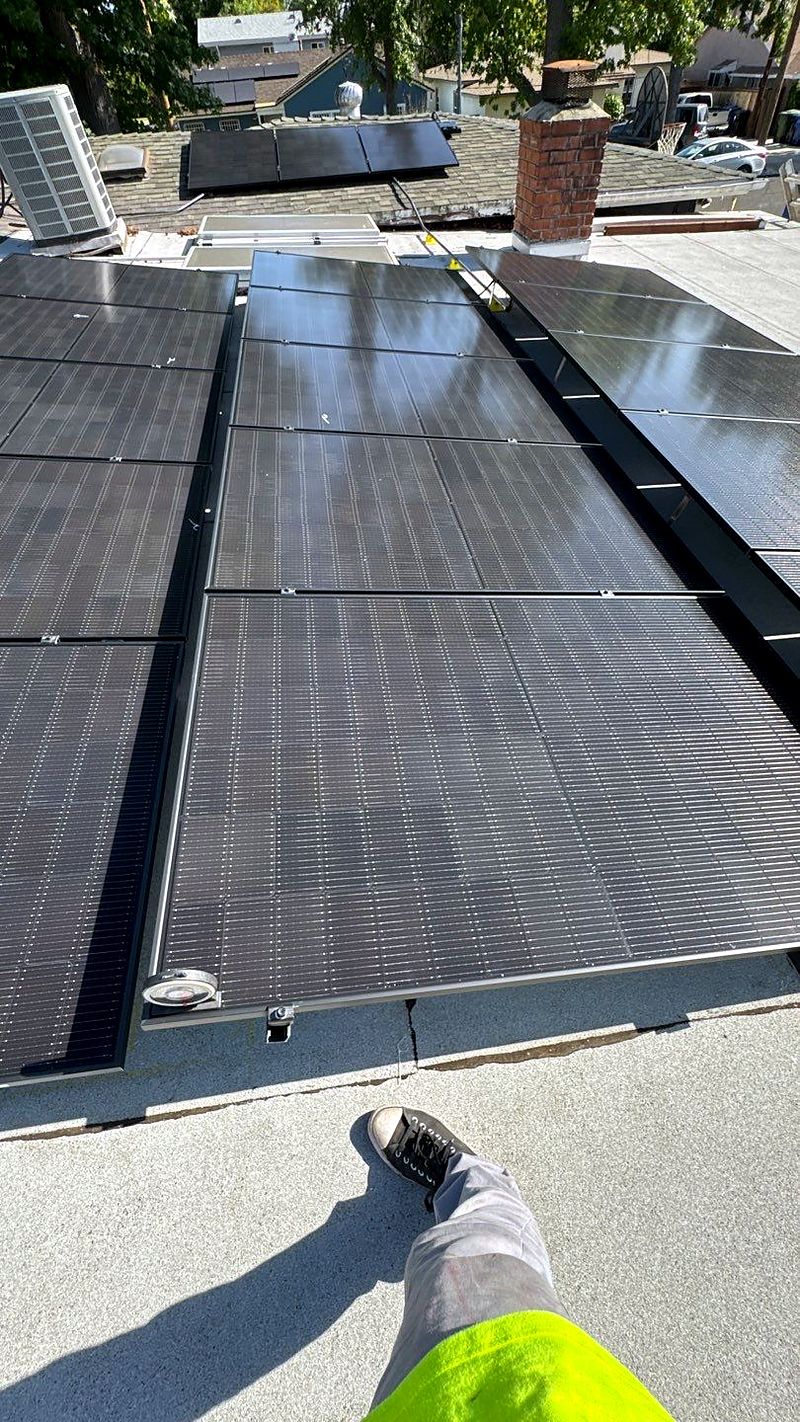
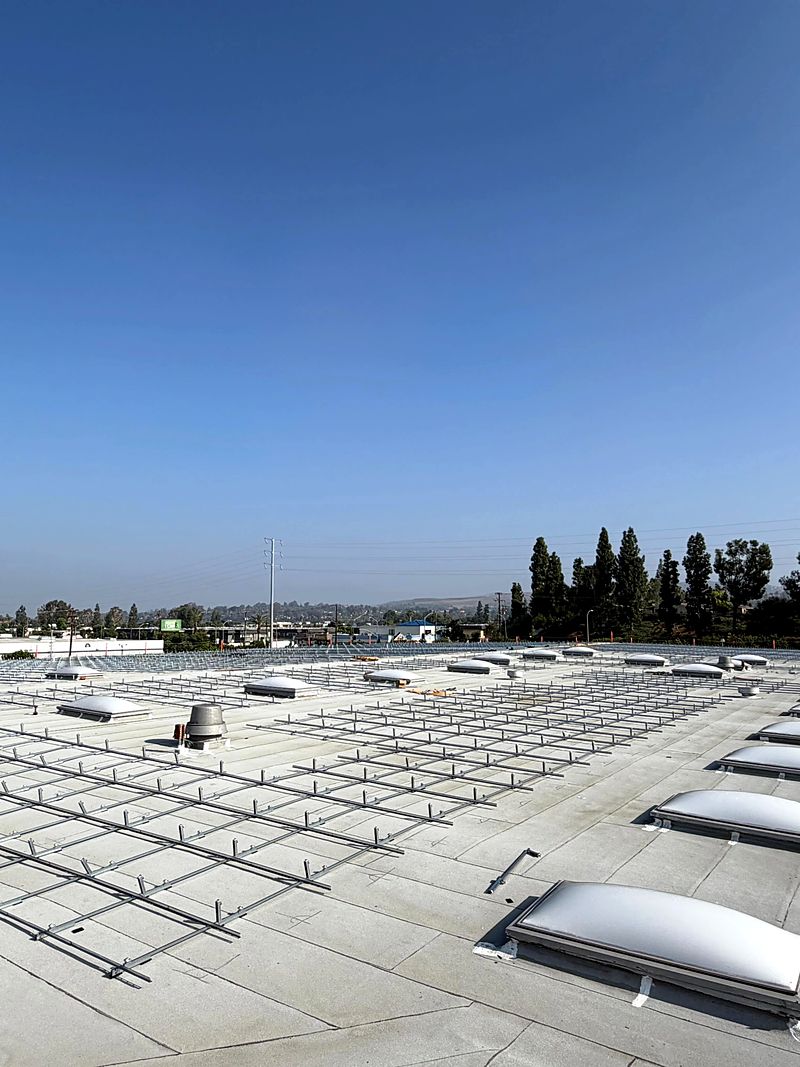
23 photographs from our own jobs →
Where we work
We work throughout the city, including Downtown Los Angeles, Mid-City, Hollywood, Silver Lake, Westwood, Century City, Vernon-adjacent industrial, South Los Angeles, Eagle Rock, Highland Park, Venice and Playa Vista, plus the San Fernando Valley. Parking-heavy sites should also read solar carports, and apartment owners EV charging for multifamily properties. Not sure which LADWP program fits? Start with LADWP solar programs and rebates.
Sources and further reading
- LADWP — EV, Net Energy Metering and REO rates — accessed October 8, 2026
- LADWP — Solar interconnection requirements — accessed October 8, 2026
- LADWP — Feed-in Tariff (FiT) Program — accessed October 8, 2026
- LADWP — Feed-in Tariff Plus (FiT+) Pilot Program — accessed October 8, 2026
- 26 U.S.C. § 48E — Clean electricity investment credit (Cornell LII) — accessed October 8, 2026
- IRS Notice 2025-42 — beginning of construction for wind and solar facilities — accessed October 8, 2026
- McGuireWoods — Federal court vacates IRS Notice 2025-42 (June 2026) — accessed October 8, 2026
- IRS — Cost recovery for qualified clean energy facilities, property and technology — accessed October 8, 2026
- Eide Bailly — OBBB energy credit and bonus depreciation changes — accessed October 8, 2026
- Lawrence Berkeley National Laboratory — Tracking the Sun, 2024 Edition (executive summary) — accessed October 8, 2026
- Lawrence Berkeley National Laboratory — U.S. Distributed Solar and Storage: 2025 Data Update — accessed October 8, 2026
Questions we get asked
Is commercial solar in Los Angeles on NEM 3.0?
No, not if the property is served by LADWP. NEM 3.0 (the Net Billing Tariff) is a CPUC decision that applies to investor-owned utilities such as SCE. LADWP is a municipal utility with its own net energy metering rider and its own interconnection rules. Parts of Los Angeles County outside city limits are served by SCE, so the first thing we check is the meter.
Can my business still get the 30% federal tax credit?
Possibly. The Section 48E credit is 6% of qualified cost, rising to 30% for facilities under 1 MW AC or projects that meet prevailing-wage and apprenticeship rules. Under the 2025 budget law, a solar facility that began construction after July 4, 2026 must be placed in service by December 31, 2027 to qualify. Battery storage is not subject to that cutoff. Confirm eligibility with your tax adviser.
Should we use LADWP net metering or the Feed-in Tariff?
It depends on what you want the roof to do. Net metering offsets your own bill and suits buildings with daytime load. The Feed-in Tariff sells the output to LADWP under a long-term contract and suits large roofs or carports on buildings with modest load. LADWP lists in-basin solar FiT prices of 13.5¢ to 14.5¢ per kWh depending on size, subject to available capacity.
How long does LADWP interconnection take for a commercial system?
It depends on size and on what the grid needs at your site. LADWP sorts systems into interconnection types; systems from 30 kW up to 1 MW require engineering review and a mandatory pre-construction meeting, and larger systems go through a separate process. We give a site-specific schedule after the feasibility review rather than a generic number.
Does Current Energy handle permits with LADBS and LADWP?
Yes. Design, engineering, permitting, installation and interconnection are handled in-house, from our office in Sylmar, which is itself inside the City of Los Angeles and LADWP territory.
What do you need from us to start?
Twelve months of utility bills or interval data, the roof age and any roof warranty, a single-line diagram if you have one, and who owns the building. With that we can tell you whether the site is worth a full design.
Last updated October 2026
A real number for your Los Angeles building.
Send twelve months of LADWP bills and the roof age. We will tell you whether net metering or the Feed-in Tariff fits, and what it takes to make the 2027 deadline.