Commercial solar carports for Southern California parking lots
When the roof is too small, shaded or near the end of its life, the parking lot can carry the array. What a canopy adds to the cost, what LADWP pays toward it, and how to read a bid.
Short answer
A solar carport puts the array on a steel canopy over parking instead of on the roof, and it costs more per watt than a rooftop system because you are paying for the structure as well as the solar. It earns its place when the roof is too small, shaded or near the end of its life, or when the lot is the biggest open surface on the site. In LADWP territory, Feed-in Tariff carport projects can also receive LADWP’s Carport & Canopy Incentive of $0.90 to $1.70 per watt. Current Energy has built carports at Van Nuys Airport, Chatsworth and Vitco Foods.
On this page
When a carport makes sense
The roof cannot carry it
Limited structural capacity, heavy rooftop equipment, skylights or a roof with only a few years left all push the array somewhere else.
The lot is the biggest surface
Retail centres, offices, dealerships and distribution sites often have more parking area than usable roof.
Shade is part of the value
Covered parking is an amenity for tenants, staff and customers, and protects vehicles from Valley heat.
EV charging is coming
A canopy is a natural home for chargers, with conduit and capacity planned once.
What a carport costs, and why
No federal laboratory or California agency publishes a price per watt for solar carports. The closest public benchmark is Lawrence Berkeley National Laboratory’s Tracking the Sun, which reported that large (over 100 kW) California systems installed in 2023 had a median installed price of $2.3 per watt at commercial sites and $4.1 per watt at tax-exempt sites, before incentives, with all mounting types combined. LBNL does not break carports out separately, so treat those numbers as the solar baseline, not a carport price.
A canopy adds cost on top of that baseline, and those costs follow the site more than the kilowatts:
- Structural engineering for an open structure under wind and seismic loads.
- Clearance height over parking stalls, accessible spaces and any fire lane; taller columns mean more steel and bigger footings.
- Foundations, usually drilled piers sized to the soil, often preceded by a geotechnical report and utility locating.
- Trenching and switchgear from the canopy back to the point of interconnection.
- Lighting, drainage and paving repair under and around the canopy, plus any accessibility upgrades the work triggers.
Because no public carport benchmark exists, a firm number only comes from a site-specific design that prices the canopy as its own line; it depends on the structure, the soil, the utility and the timeline. For the rooftop side of the comparison, see our commercial solar cost guide.
The LADWP carport incentive
LADWP’s Feed-in Tariff, which buys the output of local solar projects under 20-year contracts, adds a Carport & Canopy Incentive, paid per watt, for qualifying structures. As listed on LADWP’s FiT page:
| System size | In a disadvantaged community | Elsewhere |
|---|---|---|
| Under 500 kW | $1.70/W | $1.50/W |
| 500 kW to 3 MW | $1.40/W | $1.20/W |
| 3 MW to 10 MW | $1.10/W | $0.90/W |
That incentive comes with the FiT itself: you sell the energy to LADWP (listed in-basin solar prices are 13.5¢ to 14.5¢ per kWh depending on size) rather than using it on site. LADWP reported 57.8 MW of FiT capacity still available as of September 18, 2026, with a waitlist once it is full. More on every program at LADWP solar programs and rebates and commercial solar in Los Angeles.
Tax treatment
Business-owned carport solar can qualify for the Section 48E credit: 6% base, or 30% for facilities under 1 MW AC or that meet prevailing-wage and apprenticeship rules. Two cautions specific to carports:
- Structure versus energy property. 48E excludes “a building or its structural components” from qualified property. How much of a canopy’s steel and foundations sits in the credit basis is a question for your tax adviser.
- Schedule. A solar facility that began construction after July 4, 2026 must be placed in service by December 31, 2027. Carports add structural design, plan check and foundation steps a roof job does not have, so start early.
Qualifying 48E property is five-year MACRS property, and 100% bonus depreciation is permanent for qualifying property acquired after January 19, 2025. The federal charger credit (Section 30C) no longer applies to chargers placed in service after June 30, 2026.
Not tax or legal advice
Current Energy is a licensed contractor. This page summarises publicly available rules as they stood on October 8, 2026 and is not tax, legal or financial advice. Programs change. Confirm anything that affects a real decision with your CPA, tax counsel or the program administrator.
Design decisions that move the price
For the step-by-step process, from the utility check and site walk to permits and phased construction, see our guide to how a parking lot solar project comes together.
Single-column T or two-column
Cantilevered single-column canopies keep stalls open but need heavier members and foundations; two-column designs are lighter but put posts between cars.
Span and tilt
Longer spans reduce foundation count but increase steel; tilt trades a little production for drainage and clearance.
Interconnection distance
The run from the far end of the lot to the switchgear is real money, and so is a service that cannot accept the system without an upgrade.
Permitting and utility review
Carports go through structural plan check as well as electrical review, and utility requirements vary by territory.
Carports we have built
At Van Nuys Airport the array spans nine hangar roofs plus two carports over the parking areas: 6,569 modules in total, producing 4.5 million kWh a year. In Chatsworth, 324 modules went on two new carports alongside 3,000 on the roof, with eight EV charging stations, as a Feed-in Tariff project. At Vitco Foods in Ontario, the design put the array on parking canopies rather than the roof of a 123,000 sq ft cold-storage building, a choice the owner credited as right for the site.
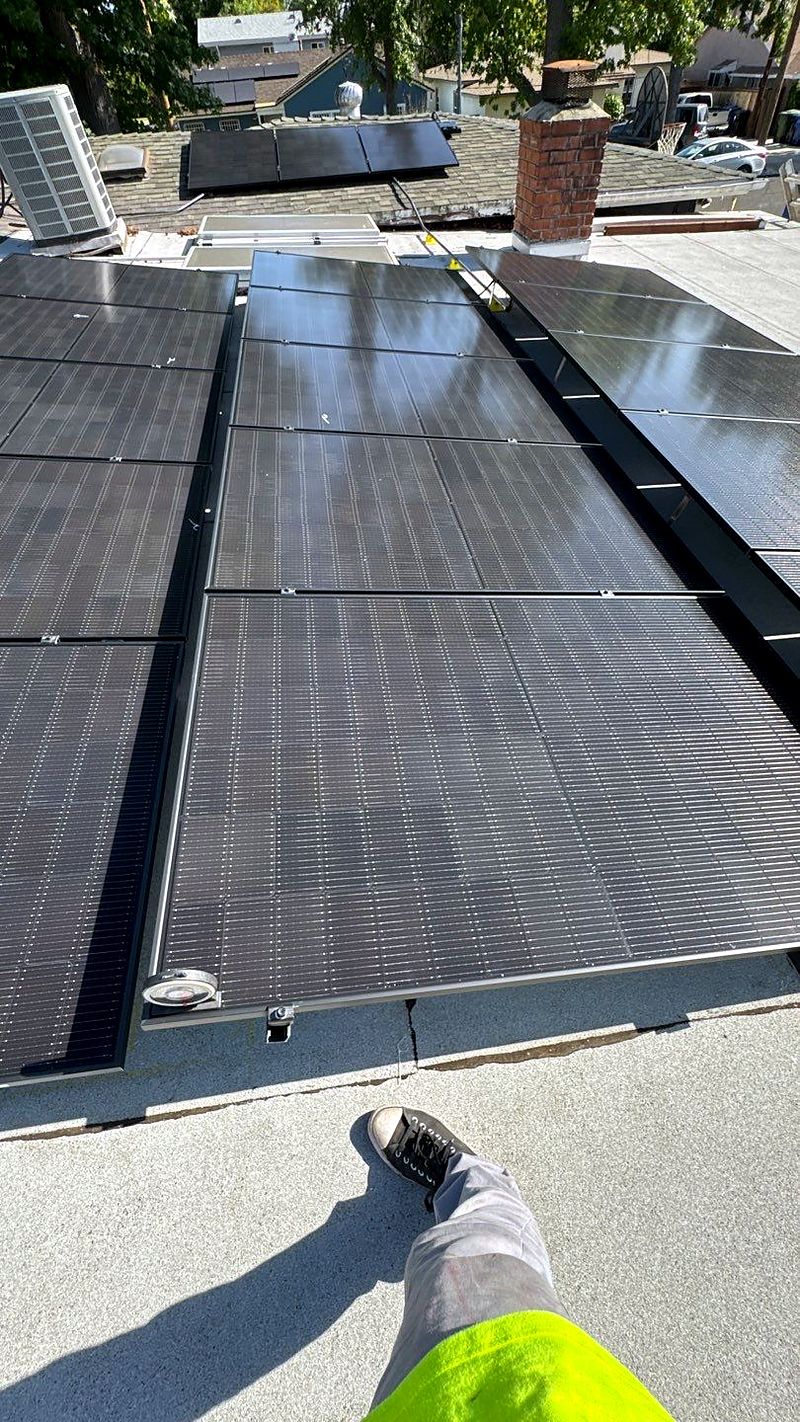
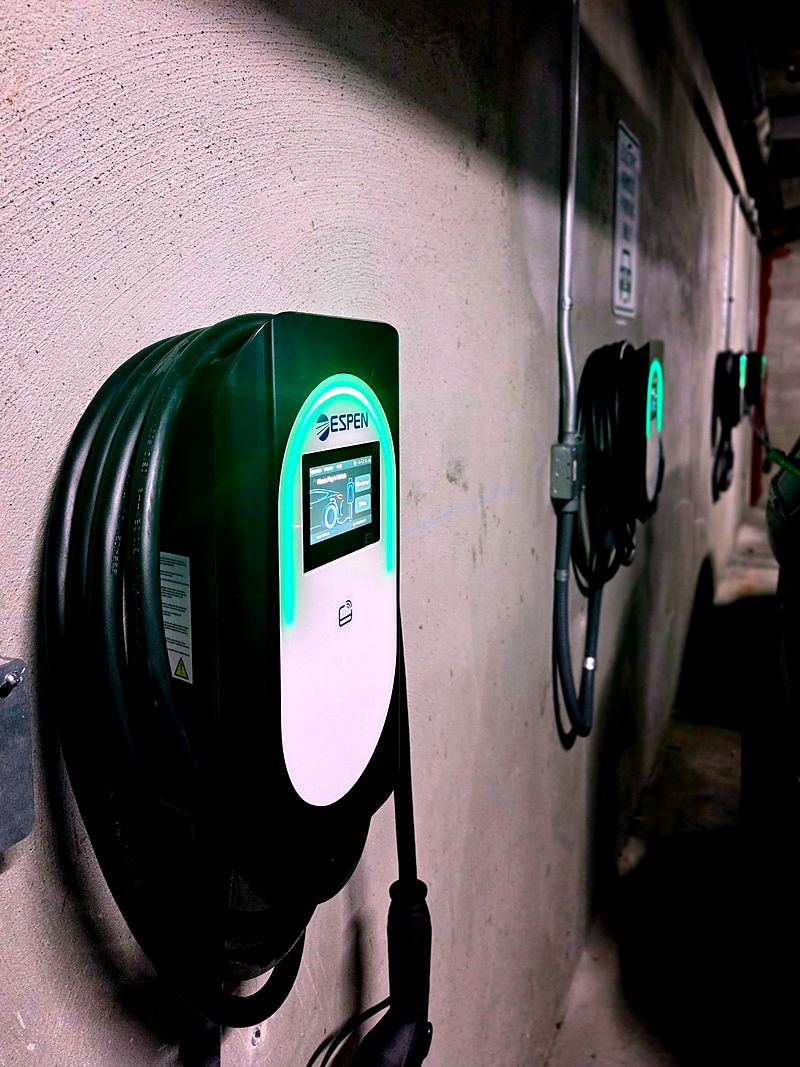
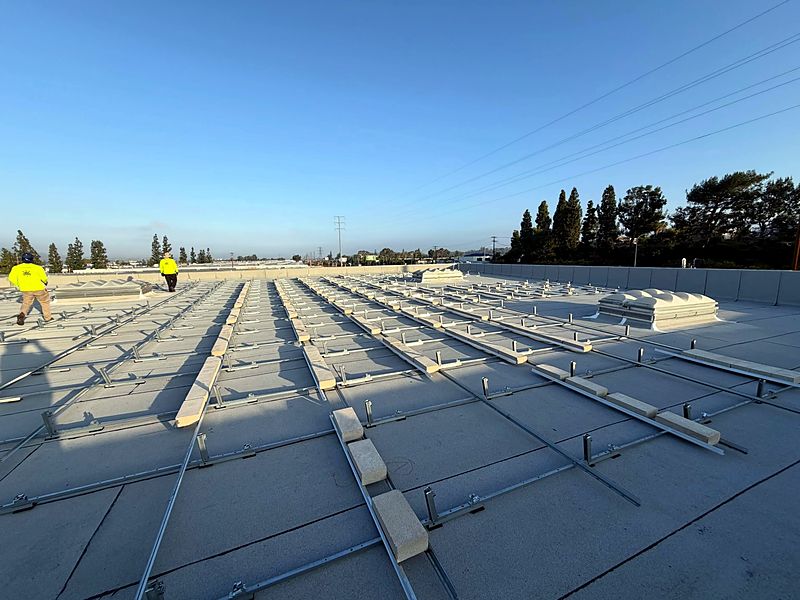
23 photographs from our own jobs →
How to compare carport bids
- Split solar from structure. Ask for modules, inverters and electrical priced separately from canopy steel, foundations and engineering. Compare the solar part per watt; compare the structure per parking space.
- List every exclusion. Paving, striping, lighting, drainage, utility relocation and accessibility upgrades are where carport change orders come from.
- Ask who signs what. Which licensed entity holds the prime contract, who stamps the structural design, and who warrants the canopy versus the solar.
- Check the schedule against 2027. If the federal credit matters to you, ask for a dated path to placed-in-service.
Sources and further reading
- Lawrence Berkeley National Laboratory — Tracking the Sun, 2024 Edition (executive summary) — accessed October 8, 2026
- Lawrence Berkeley National Laboratory — U.S. Distributed Solar and Storage: 2025 Data Update — accessed October 8, 2026
- LADWP — Feed-in Tariff (FiT) Program — accessed October 8, 2026
- 26 U.S.C. § 48E — Clean electricity investment credit (Cornell LII) — accessed October 8, 2026
- IRS — Cost recovery for qualified clean energy facilities, property and technology — accessed October 8, 2026
- Eide Bailly — OBBB energy credit and bonus depreciation changes — accessed October 8, 2026
- IRS — Alternative fuel vehicle refueling property credit (30C) — accessed October 8, 2026
Questions we get asked
How much does a commercial solar carport cost?
No public agency publishes a carport price per watt. Lawrence Berkeley National Laboratory reported a 2023 median of $2.3 per watt for large commercial solar systems in California and $4.1 per watt at tax-exempt sites, all mounting types combined. A carport adds steel, foundations and site work on top of the solar itself, so it should be priced as its own line. We quote from a site-specific design.
Why does a carport cost more than a rooftop system?
A roof already provides the structure. A carport has to be engineered and built: steel columns and beams tall enough to clear vehicles, foundations sized for wind and seismic loads, trenching back to the switchgear, and often lighting, drainage and paving repair underneath.
Does LADWP pay anything extra for carports?
Yes, within the Feed-in Tariff. LADWP lists a Carport & Canopy Incentive paid per watt on top of the FiT energy price: $1.70 in a disadvantaged community and $1.50 elsewhere for systems under 500 kW, $1.40 and $1.20 from 500 kW to 3 MW, and $1.10 and $0.90 from 3 to 10 MW. It applies to FiT projects, subject to program capacity and LADWP’s terms.
Does the federal tax credit cover the carport structure?
Section 48E covers qualified energy property but excludes a building or its structural components. Which parts of a canopy fall on each side of that line is a question for your tax adviser, so a proposal should not simply assume the whole canopy is in the credit basis. Note also that a solar facility that began construction after July 4, 2026 must be in service by December 31, 2027.
Can we add EV chargers under the carport?
Yes, and it is usually cheaper to plan the conduit and capacity for chargers while the canopy is being designed than to trench for them later. Our Chatsworth project added eight EV charging stations alongside two new solar carports.
When is a carport the wrong choice?
When the roof has the space, the structure and the remaining life to carry the array, because a roof system avoids paying for a canopy. A carport also makes less sense on a leased lot, where the parking layout may change, or where the schedule cannot absorb structural design, plan check and foundation work.
Do you build carports for schools and public agencies?
Public and school projects have their own review and procurement requirements. Talk to us about the specific site and we will tell you plainly whether it fits our scope.
Last updated October 2026
Is your parking lot the better roof?
Send a site plan or an aerial, twelve months of bills and the roof age. We will tell you whether a canopy beats the roof, and what LADWP or the federal credit can contribute.